

Setting the Example
Chris Richards
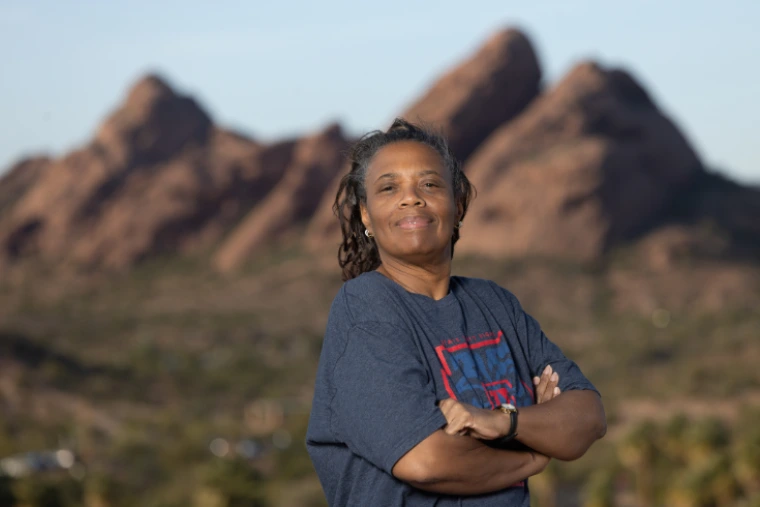
Tanya Burns ’99 came to the Eller College of Management as a single working mother and first-generation college student. Now a program specialist at Intel, she has established the Tanya L. and Korey S. Burns Family Scholarship Endowment to give students with the greatest need — in particular single parents, children of single parents, and first-generation college students — the opportunity to pursue their education, too.
I had not planned on moving 2,600 miles away from my home state of Virgina to attend the University of Arizona, but when I came across their brochure for the third time, I took it as a sign and decided to consider it. When I made the trip out in 1997, I fell in love with the weather immediately, but I also fell in love with the campus and the people I met there. U of A didn’t feel pretentious, yet you could tell you were on a serious college campus. When you’ve been searching for your own little place to fit in and finally land there, you just feel at peace.
While speaking with the East Coast schools I had considered, I was given a clear message that their graduate education programs would have to come first, above even parenting.
At U of A, when I explained that my child was eight years old and that we were a package deal — that I couldn’t make a choice between parenting and pursuing a graduate degree — everyone was supportive of me, and I was offered resources to ease my transition. I’m so glad I took the leap of faith that landed me at Eller College of Management; it changed my life and put me in a position to make positive changes for others.
When I started at Eller, I was terrified. It was my first time living on my own, and I also felt intimidated by my classmates because they were so much younger than me. I couldn’t help but wonder, “Am I going to be able to do this?” But my professors made special efforts to get to know me, and my son was welcomed into my classes — I would bring him with me when he wasn’t in school. The university had also gone to the effort of putting me in touch with African American resources, including an African American Latino resource group that met me when I got to campus. Not every school will automatically connect you with ethnicity-based groups you can identify with, so that was very meaningful to me.
Despite my anxieties, I committed to doing my best because I felt like it was very important to set an example for my son. Also, having come from a household where my mother didn’t finish high school, I knew the importance of setting myself up for a career, not just a job. So I persevered and adapted. When I took night classes, I would instruct my son to just play after school and not do his homework. That way when I brought him to class, there was less of a temptation for him to run around or be disruptive. He did his homework as I was in class, and we both learned what we needed to learn that way. In fact, he was so well-behaved, some of my professors started including him in classroom activities. I was grateful that being in a college classroom was normalized for him in that way.
I attended Eller because I wanted more opportunities and to see what was out there after not having been given much guidance in high school or during the pursuit of my associate’s and bachelor’s degrees. I was fortunate to be as supported as I was. One of my mentors insisted that those of us who were African American join the National Black MBA Association and attend the Black MBA conferences. Meanwhile, I had access to career fairs and resources to help me apply for jobs. It gave me real hope for my future. I would not be where I am today if it weren’t for my education at Eller and all of the help I had along the way.
I really believe in the power of education, and I’m worried about the upcoming generation. I think it’s so important that we keep people coming to college, and that we create opportunities for them to be able to go. I’m happy to talk with anyone who needs that extra inspiration to apply to programs in higher education, especially those who think they can’t go back to school later in life. They can. It’s really possible, and it’s worth the investment in yourself.
I’m proud to be a Wildcat, and I really want others who aspire to higher education to feel that pride too. That’s why I established an endowment that creates scholarships for people from underserved communities, with a preference for first-generation college students and single-parent households. In doing this, I can honor my own experience as a first-generation college student as well as my son’s experience. I may be a helicopter parent, but it was just the two of us when he was growing up. We overcame a lot, together and individually, and it’s especially meaningful for me to be able to extend support to others going through struggles like the ones we faced.
Fun fact: Korey also graduated from the U of A and is also a Wildcat, class of 2010. I was so proud when he chose to follow in my footsteps even though by that time we were living on the East Coast and I wanted him to attend college closer to home. I never encouraged him to apply to U of A, but he said he always wanted to apply after attending classes with me while I was in graduate school. College was not optional for him; it was my only requirement of him as his parent. I didn’t care what degree he received, but he had to get a college degree — I didn’t budge on this requirement.
I wish I had thousands and millions more dollars to contribute, but I’m also grateful that I could leave a positive mark in the world at all. I want to inspire others to know that you don’t have to be a multimillionaire to be able to fund a scholarship. A lot of us working-class people can make a difference too. I also really want to spread the word that many companies have a matching gift program, so if you make a donation to a cause you believe in, you should ask your benefits person about making a matching gift. That’s part of what has helped me get my scholarship endowment to where it is right now.
Eller helped me become successful in terms of finding a career, and I will always be grateful for that. But it’s also true that my idea of success has changed over the years. In the years since I finished school, I have come to believe that success is about giving back and trying to let the life I live be an example, especially for my son. When I was younger, especially as a student, success was about making my own way, but now it is about supporting others. It’s about leaving a legacy. That is why I’ve created scholarship funds. I want to continue helping others even after I’m gone.
To learn more about including the U of A in your estate plans, visit uafoundation.giftplans.org or call 520-621-1993.


