

Making Every Second Count
Astrophysicist, director of the Arizona Space Institute and content creator Erika Hamden has made it her mission to prove that the pursuit of knowledge is worth your time.
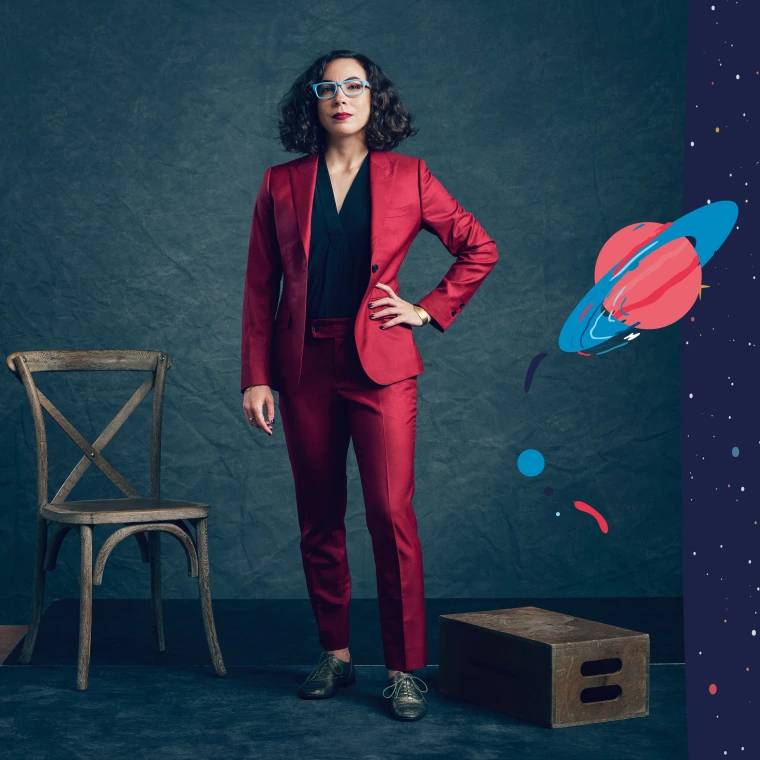
Photo: TED
Erika Hamden has a philosophy she describes as “somewhat grim”: One day she is going to die.
“The only thing that is truly valuable is time,” she says. “Am I doing something that is meaningful?”
It’s the kind of question most people avoid, let alone think about daily. For Hamden, it’s her fuel.
She is, depending on whom you ask, a telescope builder, a tenured professor of astrophysics at Steward Observatory, the director of the Arizona Space Institute, a TED fellow, a NASA honoree, a 2026 Guggenheim fellow and — to a quarter million people across Instagram and TikTok — a content creator who turns complex science topics into entertainment.
She does all of it, for the record, in very cool glasses and a bold lip.
Born in New Jersey, the fourth of five sisters, Hamden had a fascination with space from a very young age. As a kid, she figured out how to program her VCR to watch PBS documentaries.
“It was my thing,” she laughs. “I just wanted to learn everything there was to learn.”
In high school, she made what she called her “life plan”: go to MIT and become an astronaut. It didn’t go as planned.
“I went to MIT and hated it. I dropped out.” It was, she admits, a difficult time — but necessary. “When I look back on it, it was really helpful and I was forced to figure out who I was as a person.”
She transferred to Harvard and earned her bachelor’s degree in astronomy and astrophysics. Then, instead of heading straight to graduate school like her peers, she enrolled at Le Cordon Bleu in London and worked briefly in a restaurant.

“Being a chef is an incredibly hard job,” Hamden says. “And I really missed learning and using my brain in an analytic way.”
She had deferred her graduate school admission for a year, but returned to earn two master’s degrees and a doctorate from Columbia.
“Because of my experience dropping out of MIT, I’ve always felt like I want to make sure I’m doing something I love in the moment,” she says. “Not waiting for some future payoff that may or may not happen.”
Hamden has built numerous telescopes throughout her career, including the FIREBall-2, a UV balloon-borne telescope that was built to observe faint emissions from distant galaxies.
During the coronavirus pandemic, a CBS children’s science program called “Mission Unstoppable” asked Hamden if she could record a quick video sharing space facts for their social media.
She shot it in her living room. It got half a million views.
“I was like, ‘Oh, wow!’” she laughs. They asked for another. And another. Eventually, Hamden started posting under her own name.
She’s careful to say she isn’t trying to be an influencer. What she’s doing, she says, feels more like a responsibility. In a media landscape she describes as thriving on confusion and uncertainty, Hamden wants to be a voice that insists it is possible to know things.
“Scientists have an obligation to be in communication with the public,” she says. “I think our society is in a state of crisis because of the lack of participation by scientists. ... In science, there is a very clear link between cause and effect. There is an agreed-upon reality that we share.”
That conviction led to her book, “Weird Universe: Everything We Don’t Know About Space (and Why It’s Important),” which she wrote after a publisher discovered her videos.
While the book describes complex topics such as black holes, galaxies and space-time, Hamden says she wanted every chapter to feel as digestible as an Instagram reel. Not because she’s oversimplifying or diluting information, but because she believes anyone can learn anything if they want to and have the time for it.
These days, Hamden is in the classroom at the University of Arizona, a place she wasn’t too sure about at first. But on her first day, astronomers George and Marcia Rieke showed up at her office door and welcomed her with a hug. She had no choice but to fall in love.
Now, Hamden is looking ahead. She’s the deputy principal investigator for the U of A-led NASA Aspera mission, which will study galaxy evolution through observation of ultraviolet light.
That “life plan” isn’t entirely off the table, either. She still hopes to become an astronaut.
“Space is awesome,” she says. “The University of Arizona is the best place in the world for space sciences. It’s such a treat that it’s my job to come here every day and do it.”


