

New Light, Old Rituals
U of A researchers are using laser mapping technology to reveal early Mesoamerican ritual sites.
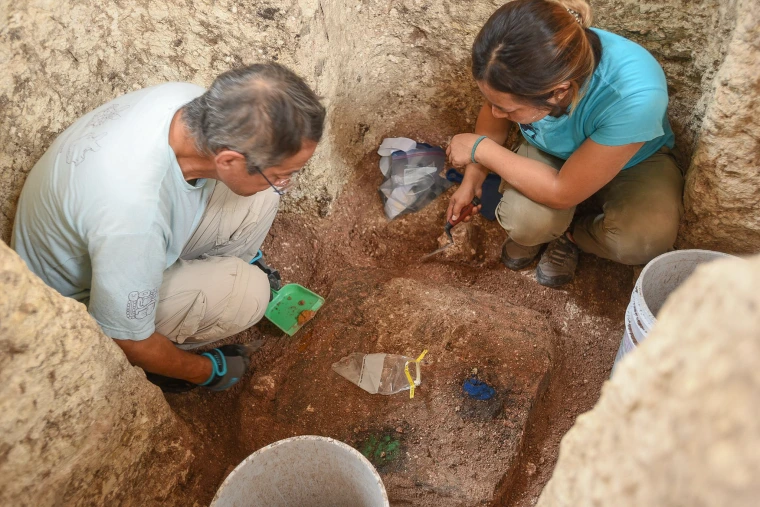
U of A archaeologists in the College of Social and Behavioral Sciences, Takeshi Inomata (left) and Melina García, excavate a cache of ceremonial artifacts including mineral pigments associated with the cardinal directions.
Photo: Atasta Flores
In the state of Tabasco, in southeast Mexico, most roads are unpaved and stretch for miles alongside pastures and crops that have been turned a lush green by the Río San Pedro. Most people passing through would likely just see rolling farmland.
But in 2020, a team of archaeologists, including University of Arizona Regents Professor of anthropology Takeshi Inomata, used cameras and laser-drone technology to peer through a layer of earth. To their surprise, their images showed a mile-long construction, probably from 1,000 B.C. The site, called Aguada Fénix, is believed to be one of the largest monuments built in the Maya area.
The discoveries have continued, thanks to both imaging and more traditional excavations. Last summer, Inomata and the team unearthed evidence that Aguada Fénix was a cosmogram — a model to represent the universe, seen at other Maya sites — which could make it among the most significant ceremonial sites in the Maya area. The latest excavation revealed a cross-shaped, or cruciform, pit that held a cache of ceremonial artifacts providing unprecedented information on early Maya rituals.
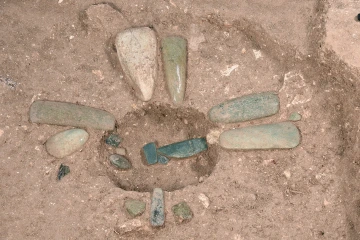
The team excavated jade axes and ornaments that were likely left after builders had made offerings to the cruciform cache and filled it in.
Photo: Takeshi Inomata/University of Arizona.
Inomata’s findings, published in November in Science Advances, challenge the long-held belief that Mesoamerican cultures expanded slowly over time. Instead of gradually building up to major cities like Tikal in Guatemala or Teotihuacan in central Mexico, Inomata’s research shows that large ceremonial centers existed much earlier. Aguada Fénix predates both cities by nearly a thousand years — and is as large as they are, if not larger.
“What we are finding is that there was a ‘big bang’ of construction at the beginning of 1,000 B.C., which really nobody knew about,” says Inomata. “Huge planning and construction really happened at the very beginning.”
Inomata and his colleagues first found clues to the presence of Aguada Fénix in 2017 by using lidar, a laser technology, to scan jungle and forest to create 3D maps of human-made structures. They had discovered early constructions at the Maya site of Ceibal in Guatemala using the same technology and found that Aguada Fénix was arranged in a similar way.
At Aguada Fénix, the monument’s centerline aligns with the rising sun on Oct. 17 and Feb. 24 — a 130-day span that researchers say likely marks half of the 260-day Mesoamerican ritual calendar. This pattern, seen at other Maya sites, also led archaeologists to expect — and ultimately find — the cruciform pit containing a cache of ceremonial artifacts.
The team used radiocarbon to date the cruciform pit and the construction layers above it. Researchers also analyzed sherds of ceramic material that helped date the pit.
Their first significant find included several axes made of jade, which researchers recognized from previous excavations as ceremonial. “That told us that this was really an important ritual place,” Inomata says.
As excavation continued, the team found ornaments carved from jade representing a crocodile, a bird and what they believe is a woman giving birth. At the bottom of the pit was a smaller, also cruciform pit, where they found mineral pigments — small piles of blue, green and yellowish soil — arranged in the cardinal directions.
“We’ve known that there are specific colors associated with specific directions, and that’s important for all Mesoamerican people — even the Native American people in North America,” Inomata says. “But we never had actual pigment placed in this way. This is the first case that we’ve found those pigments associated with each specific direction. So that was very exciting.”
The builders, researchers suspect, arranged the pigments and other materials as an offering, then filled it in with sand and soil. Radiocarbon dating estimates that the cache dates to 900-845 B.C. People likely returned to the site for later rituals, leaving behind the jade objects.
The study also revealed a network of raised causeways and sunken corridors that Aguada Fénix’s builders used to walk to and through the site, as well as canals and a dam to divert water from a nearby laguna. The causeways, corridors and canals followed axes that ran parallel to Aguada Fénix’s orientation with the sun and extend as far as six miles away from the monument’s main plateau.
While some sites, like Tikal, were presided over by a single, powerful king, the team has so far found no evidence that Aguada Fénix was constructed under that model. Inomata’s theory is that Aguada Fénix instead had intellectual leaders who made astronomical observations and led the design and planning for the site.
“These leaders didn’t have power to force other people,” Inomata adds. “Most came probably willingly, because this idea of building a cosmogram was really important to them, and so they worked together.”
Xanti S. Ceballos Pesina, a doctoral student in the School of Anthropology and a co-author on the study, helped excavate a smaller complex within Aguada Fénix. Ceballos, who grew up in Mexico, has visited numerous Maya sites as an archaeologist.
Looking at Inomata’s lidar map of Aguada Fénix, Ceballos says she was blown away at how extensive Aguada Fénix is and how it eluded researchers for so long.
“It’s very impressive that in the Middle Preclassic Period, people with no centralized organization or power were coming together to perform rituals and to build this massive construction.”


